
|
|
If the font size on this page is too small, or the page width too narrow, please just hit We are still providing DNA testing as of 2026. DNA Testing in Thailand for PaternityWe have experience in Thailand with DNA testing going back to the mid-1990s. In 2011, we created a new website to focus on the complex topic of DNA testing, as paternity testing is a topic needing a lot more explanation that is appropriate for this website, and people had a lot of questions about the process for doing a DNA paternity test in Thailand with our company. That website is https://www.thailand-dna-test.com That new site supercedes this simple page. Nevertheless, we will keep this page up as it was before, more or less, with some additions. Our main purpose in DNA paternity testing is finding out whether or not a man is the biological father of a baby. The result is normally one of two things:
The phrase "paternity fraud" is very common, which in my mind refers to a lady who has tried to convince a man that he is the only possible father, even though she may know that is not true, or might not be true, with the intention of extracting financial support from him. However, many of our cases are not of fraudulent intent, as many of the mothers honestly say they cannot be sure until they test. Usually, we test one father at a time, but occasionally, we are presented with more than one possible father at the same time, so we are asked to find out which man is the father of a particular baby. We have also done tests for many official purposes, including for foreign embassies, Thai citizenship (for the Thai government), for the Thai court, for "amphur" (district office) documentation, and other applications. With us, you can do your case anonymously. You can use an alias when you meet us. You can even deal with us by postal mail or messenger if you prefer. Either one of our four DNA collection specialists can take the DNA samples from all participants, or else we can postal mail or give you a "kit" whereby you can easily collect your own samples in your own location when convenient, after reading our simple instructions. However, if you need to use our test for official purposes, then one of our DNA collection agents must swab all participants and control all samples, and we need to see government issued photo IDs for adults and take a photo of all participants at the time of testing. For a child, either a government photo ID or an original birth certificate are acceptable for a name. We are accustomed to keeping information private. Our Managing Director previously worked in the national security field handling highly secret information and materials, and we have standard operating procedures for handling things. Together with your samples, we also collect all authorized means of contact with you -- approved phone number(s), email address(es), and any other means. DNA samples are normally swabs of the inside of the cheeks. No blood and no pain. The result is normally over 99.99% probability or 0%, not in between, for a standard paternity test. We do not even need a sample from the mother. However, if the mother also participates, this is encouraged. We do not charge extra for the mother for this reason. Same price, not more. We have an established relationship with a top laboratory for collecting and analyzing DNA samples, including for paternity testing. For this laboratory, which is AABB certified (the US standard), as well as certified by the authorities in the UK, Australia, and Canada (see our other website), we are authorized to provide the scientific reports of the results directly from the laboratory in the USA, which includes the standard US laboratory's calculation of the probability of paternity (which is either 0% or 99.99+%), and we can explain the results in scientific detail to you, in native American English. (I am a physicist by degree, but this is not rocket science, it is basic genetics.) Sometimes a person brings us "forensic" samples, such as fingernail clippings, hair with roots, cigarette butts, chewing gum, and other things. We can process these, too. Some people have traveled to us from other countries with special samples ... We can handle some special cases, too.
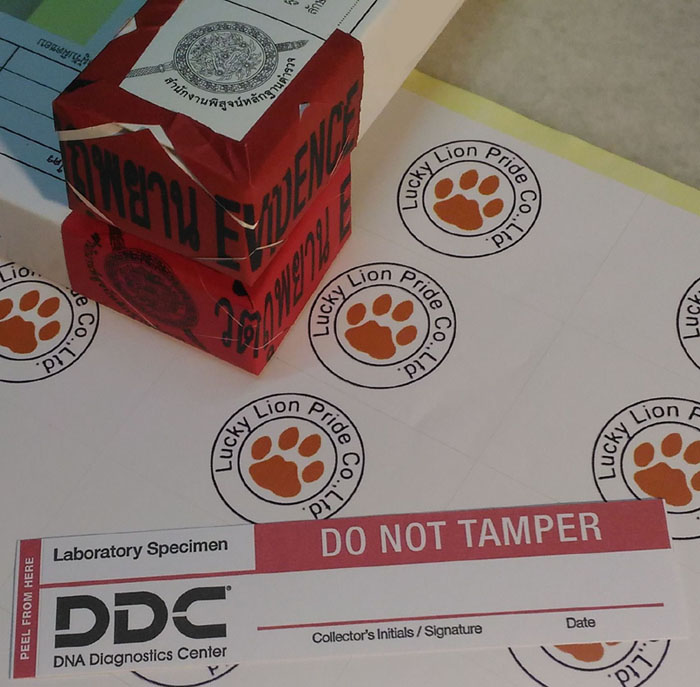
We have a "legal chain-of-custody" option, too, but most people request the quick and easy method instead, at least at first, in order to avoid additional costs and legal issues. By "legal", we mean admissible in court or for immigration purposes, which means the sample collection session is photographed and sealed with tamper detection wrapping, and we require full identification of all parties to be provided, and various documentation must be filed out. See below. Most people do not do this "legal" option, but some do for immigration or court cases. The DNA samples we privately collect are simply wipes of the inside of the cheek to collect cheek cells lining the mucus membrane inside of the mouth (epithelial cells), which come off easily with our swabs. We have collection kits here which our laboratory provides us from the USA. The swabs for the cheek samples looks like a cotton swab except the stick is much longer and the swab on the end is actually a different material than cotton, slightly more abrasive and made of a material which sticks to epithelial cells. You don't need to be a certified lab technician to collect the samples in the field, as long as you are very, very careful. However, we have four DNA sample collection specialists who are experienced at taking DNA specimens. Various other details:
Please note: We prefer to do DNA paternity tests within the first few years of the life of a child, and the earlier be better, before emotional bonds get too strong. However, we can do it at any age, though there are sometimes psychological issues we should address with older children. The kinds of DNA paternity tests we prefer are:
Unfortunately, sometimes we get fathers who have a child who has grown up but the father can't see much of a resemblance to himself, so he wants a DNA test done to find out whether or not he is the biological father. We prefer to not perform this kind of test for either of these reasons:
When we say that we "prefer" not to do a particular test, we do not rule out doing them. Many times, we have done a DNA paternity test on grown children for various personal reasons. If somebody is definitely going to do a paternity test, then they may as well do it with us to at least make sure it's accurate, but it is important to do it in a sensitive way and with considerable psychological preparation in advance for all involved. Of course, doing DNA paternity testing for embassy or immigration matters, adoption cases to check a possible alleged biological father, and various other reasons are reasonable with adult participants, and present no such issues to us. The kinds of DNA tests which must be done cautiously if at all are with, for example, school age children who have grown up all these years with a social father who they have a strong emotional attachment to. If you wish to go thru normal Thai methods, there are only a few places you can go, which have required a lot of official paperwork and some may require a blood sample, plus you must deal with the Thai language. As of the time of this writing, the waiting period for results is typically 30-45 days. With us, you will walk away with a report in good English stating clearly the laboratory's standard calculated statistical probability of paternity, using a standard American method, which is over 99.99% or else 0%, as noted above. If you wish to keep your DNA physically painless, avoid bureaucratic requirements, as well as have the samples collected at your home (especially if outside Bangkok), then consider our method, perhaps at least for the first test to find out the results before you invest heavily into any legal requirements. With our method, you do not even need to give us your real names. If interested, please contact us.
"Paternity fraud" is when a mother tricks a man into believing he is the biological father of a child, when in fact it is another man, usually to receive financial support from the tricked man. (Actually, she may or may not be sure whether or not you are the father.) Many fathers will abandon a child which they think may not be theirs. It is better to find out the truth. If it is their child, they can be more confident and fully supportive, and do the right thing, with peace of mind. If it's paternity fraud, then the man can leave with a clear conscience and a socially clean record. We have both saved family relationships when we find out the man is truly the father, as well as saved innocent men from fraud when we found out he is not the father. It is best to do this while the child is still a baby, and as soon as possible, so that there is no psychological trauma to the child and everybody involved. Better sooner than later, to resolve everything clearly, and stop losing sleep and dealing with all the mental overhead of uncertainty. We normally do DNA tests only as regards babies, not grown children, to find out before the baby becomes a child and bonds to a particular father or establishes a personal identity. Many extended family members of the Thai mother will adopt a child in the family, especially if it has foreign blood. A man who wants to be a good kind of person, or not wanting to be a bad kind of man, may consider taking partial responsibility for a new part of himself in the next generation, the result of an act which he is equally responsible for, or harbor some similar issue of morality or honor. It is relatively very cheap to raise a child in Thailand, e.g., by related Thai social parents instead of the biological parents. Nonetheless, the man may still be hesitant to get involved due to various financial, emotional, or situational issues involved in this longterm situation. If the man is not sure whether he is truly the father, then he is much more likely to reject or limit his support for that reason, if he has any doubts whether he is the father. This may happen at a later date when he desires to rationalize. A DNA test can resolve any uncertainty about the biological father, so that the issue is settled in your minds, and a situation more fair to all is likely to be arranged, stable and without lingering doubts. If the mother can find out who the father truly is, then the child will know who their father is, which is important for the child to have a complete identity. Of course, some people object to paternity testing, wanting every child to believe they are from any particular father, correct or not. We disagree. Our philosophy, which is also the majority in the world, is that we should be fair to all parties involved, based on the truth. In those cases in which the alleged father is excluded, the mother can then turn to another father, or, if she still does not know who the biological father is, at least she can manage that situation more responsibly for the longterm, such as adoption by an extended family member, or some other arrangement while the child is still a baby. It is better to resolve the issue sooner rather than later. It is traumatic to children to have an unstable family with distrust and lingering doubts. Whatever your opinion, please respect others' opinions and do not try to enforce your opinion on others.
The cost depends on your location and the situation. For example, are you in Bangkok or an outer province? Is the mother cooperative, or do we need to do the test discreetly? These are the two most common cost factors. It costs the same whether or not a DNA sample is taked from the mother (we do not wish to discourage in any way a sample from the mother, and the overall cost is not significantly more). The results are over 99% accurate whether or not a sample is taken from the mother. You get a printout of the results. It is a list of the gene alleles of the child alongside yours and optionally the mother's too. Generally speaking, each of the child's genes consists of two alleles, which make up the two halves of the gene, one from the mother and one from the father. You can see clearly in the report your alleles, the child's alleles, and optionally the mother's alleles. You will either see your alleles in the child or else see a mismatch. We test 20 allele loci to normally get over 99.99% accuracy, and we can go up to 36 loci at extra cost if you wish. Normally, there will be a match between father and child for an allele at every locus. It is rare but possible that there might be an allele mismatch at one locus due to a mutation. Some literature has estimated a mutation in one out of every 3000 paternity testing cases, but our experience is that it is more common, as we've had a few cases with a mutation out of hundreds of cases over many years. We do not exclude a father until we get 3 mismatches, but to date we have never seen more than one mutation. When we get a mutation, we continue testing additional loci at no extra cost until the probability of paternity is over 99%. Normally, it is very clear whether or not a man is the father, and the result is either 0% or over 99%, nothing in between. Very clear. The particular loci chosen for a paternity test by our affiliated laboratory are the standard ones for the best class of paternity tests in the USA, chosen because they are the loci which have a lot of variation of alleles between humans. The USA has led the world and established the best standards. DNA paternity testing has been around for decades but the blood or tissue sample required and technological accuracy issues kept it out of the mainstream. In the 1980s, techniques were developed which allowed smaller samples and greater accuracy, and the application of DNA to forensics and court cases started to shoot up. One of the techniques of the 1980s became standardized in the 1990s whereby a small sample could be greatly amplified by the PCR method (polymerase chain reaction), giving high accuracy with a small sample. (I did my first DNA paternity test in 1996 in a leading Thai laboratory using a blood sample but it could not yield the high probability of the US techniques, but I linked up the Thai technicians with a free subscription of an important journal...) With our paternity test today, which we use in this business, all we need is some cheek wipes with our special swabs to get either quick and clear "exclusion" which is a 0% chance you are the father, or else over 99.99% "inclusion" which is an extremely high probability that you are the father, and if you want 99.9999999% then we can do that too albeit at a higher price (up to 36 loci). The 20 loci test is standard as of 2016. Is a 99% chance you are the father good enough for you to be convinced "I am the father"? There are a lot of DNA tests for many different purposes, such as to determine whether a disease is inherited from parents or from something in the environment. However, a paternity test should focus on specific "loci" which have a lot of variation between men. Our test is not a cheap one, it is in the top class, and our probability calculations for inclusion/exclusion are proper whereby it's over 99% or else 0%. If the mother also submited a DNA sample, then you can see exactly how your genes came together more clearly. One will come from the mother and the other from the father. If the mother did not submit a sample, then you can still see your alleles or else the mismatch to exclude you, which is still abundantly clear. For cases in which you are "included", the probability of another man having and contributing the exact same alleles as yourself is extremely small, less than 1%, when you compare a list of genes, due to the genetic variation between humans for these particular alleles. We can explain the results to you when you receive them. Also, you can verify them with the US laboratory and communicate directly with the lab. You get the results in a table. You can see for yourself, and you have a record. Paternity is a very important issue in life, affecting a lot of people, so it's important that the testing is done the best way.
DNA results will have a big impact on peoples lives, so we do not cut any corners. The laboratory we use is one of the oldest and most established DNA testing laboratories, having provided this service for more than 10 years. It has been a leader in many ways, and maintains high quality management, staff, and standards. Laboratory accreditations include: ISO/IEC 17025 international laboratory accreditation, which is the ISO international standard for laboratory procedures and capabilities. ASCLD/LAB-International -- American Society of Crime Laboratory Directors/Laboratory Accreditation Board, which is the most stringent accreditation program for forensic DNA laboratories. ... plus several others. Its past 16 inspections have resulted in perfect ratings. This laboratory was used to get results in many high profile cases. In the standard operating procedures of this laboratory, your samples are independently tested by two separate teams. We take 4 samples from each of the child, the father, and optionally the mother, i.e., 8 to 12 samples total, whereby these are split for the two teams to each get half of the samples. The laboratory documents each and every step in order to properly identify and track every sample. In the end, the results of the two independent teams must match. The results are guaranteed, or else your money is refunded or we will do another test at no extra charge for standard DNA samples. (If you use nonstandard DNA samples such as clothing, toothbrush, etc., the offer of a refund or additional test may not apply.) To date, we've not yet had any failure for a standard cheek swab DNA sample test using our special swabs. Our laboratory is of exceptional quality. As a scientist myself (physicist), I've conducted a considerable amount of laboratory work myself, and I've been in a lot of laboratories and seen a lot of carelessness, cut corners, paperwork errors, confusion, and sloppy work in some hospitals and laboratories, sometimes covered up. Because DNA results will have such a big impact on peoples lives, I have been very careful to choose the best laboratory and people to work with. This, I have done for you already, and am making available to all.
There are two kinds of test: "private" and "legal". In the "private" test, we do not need your ID and we will accept any names you give us. This is a most convenient and economical way. However, the results are "for your information" only. They may or may not be presentable in court or for immigration. It depends on your country or local laws. In the "legal" test, we need proof of your identity in the form of government issued ID and the child's birth certificate, will take photos of all individuals giving samples during the sample collection process, will take fingerprints, and must do "Chain of Custody" documentation during the entire process. This is considerably more expensive than a "private" test. You should also check the requirements of your particular country. This is something we should prepare in advance for. We assume that people want the "private", not the "legal", test unless you state otherwise. (Some people do the private test first, and then follow up with the legal test only if necessary at a later date for any reason. Some courts will order a legal test.) The results are sent to you by email and the report will be very clear, listing your DNA results next to the child's so that you can see very clearly the result, and we will give the numeric probability calculated from this (normally either 0% of 99%). If you wish to have a printout from our office, we can do that as well. Please always make an appointment, not just walk into our office unannounced for a DNA test. We have particular staff trained to properly collect the samples, but they are field staff and not always in the office.
|
||||||||||||||||||||||||||||||||

 |
|||||||||
|
|||||||||
| www.ThailandPI.com |  |
Home | People Finder | Thai Lady | SiteMap | DNA Test | About us | Contact us | |
Menu:
Site Map
This website is about
Thailand Private
Investigations
Site Map
The Site Map
is also the
center tab
on the menu
on the top
and bottom
of every page.